

On 14 April 2025, IMC hosted a new session of its International Mangrove Wetland Lecture Series. Prof. Lin Guanghui, Professor of Ecology at the Department of Earth System Science of Tsinghua University and Chief Scientist of the Hainan International Blue Carbon Research Center, delivered a lecture entitled “Global Mangrove Conservation and Blue Carbon Monitoring and Utilization.”
Participants from the IMC Interim Secretariat, affiliated institutions of the National Forestry and Grassland Administration, the Chinese Academy of Forestry, the China Wetlands Association, the Urban Planning and Natural Resources Bureau of Shenzhen Municipality, the Guangdong Neilingding Futian National Nature Reserve Administration Bureau, as well as researchers from Tsinghua University, Xiamen University and Shenzhen University joined the lecture both online and in person.
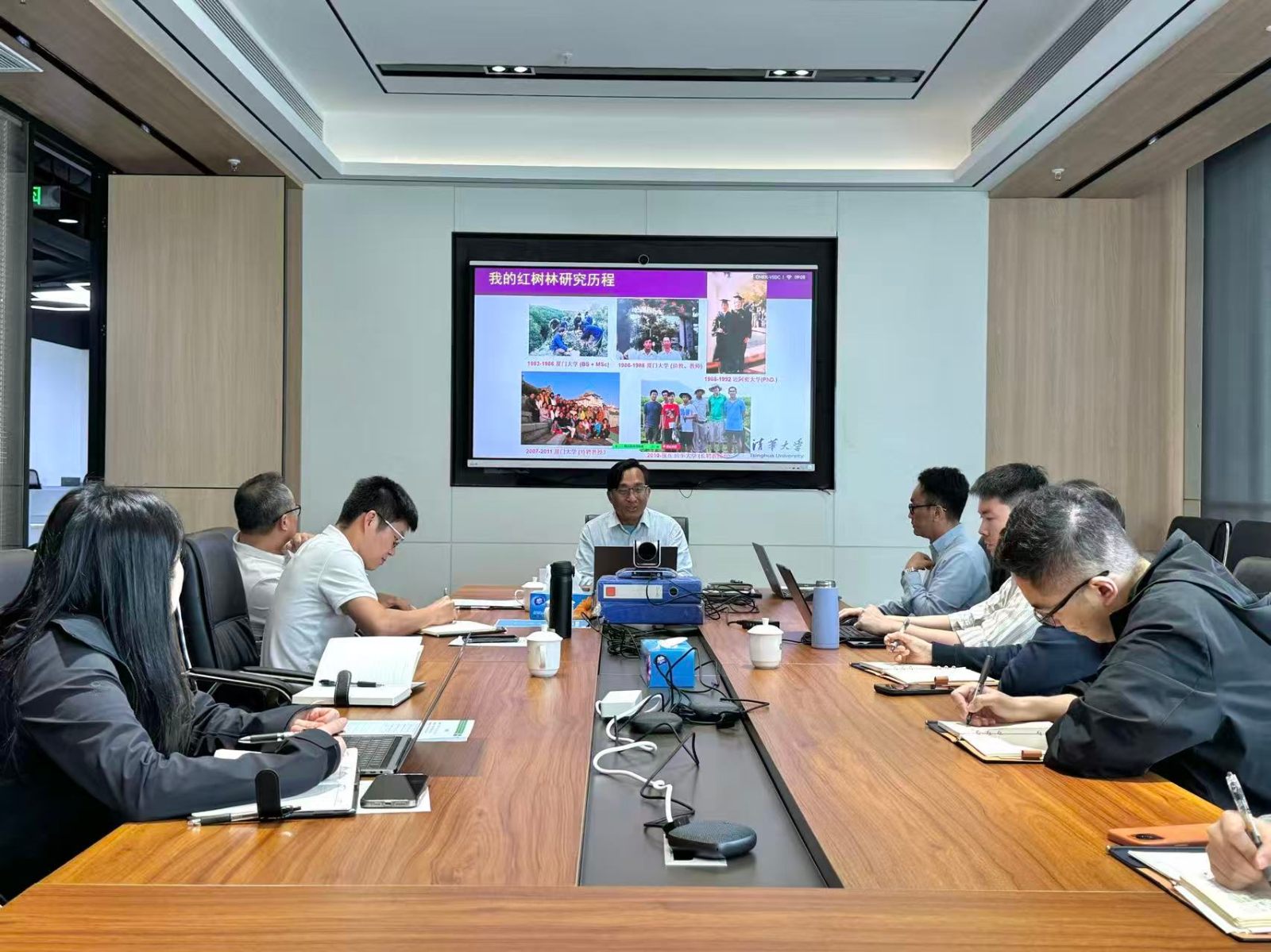
During the lecture, Prof. Lin leveraged on more than four decades of research on mangrove ecology to examine three key areas: the global distribution and conservation status of mangroves, the ecosystem services they provide, and advances in blue carbon monitoring and market-based applications. He emphasized that mangroves are not only significant carbon sinks but also play irreplaceable roles in coastal and biodiversity conservation. Prof. Lin also presented his team’s research on stable isotope tracing and blue carbon sequestration assessment, offering scientific insights that can support the development of evidence-based mangrove conservation policies.
During the interactive session, participants raised questions on topics including governance strategies for mangroves in Shenzhen Bay and the management of intertidal mudflats. Prof. Lin noted that mangrove management should be tailored to local ecological conditions. In the case of Shenzhen Bay, he suggested balancing landscape considerations with ecological functions and cautioned against the introduction of non-native species. While dredging can provide a rapid solution for pollution removal, he also stressed that, from the perspective of natural mangrove succession, human intervention should be minimized where possible, with management measures determined according to site-specific conditions.
The lecture helped participants gain a clearer understanding of global mangrove distribution patterns and the threats facing these ecosystems, while also highlighting the application of emerging technologies, including carbon and water flux monitoring. Discussions emphasized the critical role of scientific research in informing conservation policy and provided a stronger theoretical foundation for future mangrove conservation and restoration efforts worldwide.
As an important platform for global mangrove conservation, the IMC continues to prioritize capacity building in mangrove conservation, restoration, and wise and sustainable use of mangrove ecosystems, contributing to the high-quality development of global mangrove conservation efforts.