

On December 18, 2025, the International Mangrove Center (IMC) hosted a new session of the International Mangrove Wetland Lecture, inviting Professor Shi Suhua from the School of Life Sciences at Sun Yat-sen University to deliver a thematic lecture. Professor Shi shared the latest research findings and scientific insights on the evolutionary history, genomic adaptations, and genetic structure of mangroves, as well as the potential risks they face in the context of global environmental change. Participants included representatives from relevant units of the National Forestry and Grassland Administration, the Chinese Academy of Forestry, the China Wetlands Association, the Urban Planning and Natural Resources Bureau of Shenzhen Municipality, the Guangdong Neilingding Futian National Nature Reserve Administration Bureau, Peking University Shenzhen Graduate School, Sun Yat-sen University, Shenzhen University, the Mangrove Conservation Foundation, and the IMC Interim Secretariat. These attendees gathered for a session of learning and exchange.
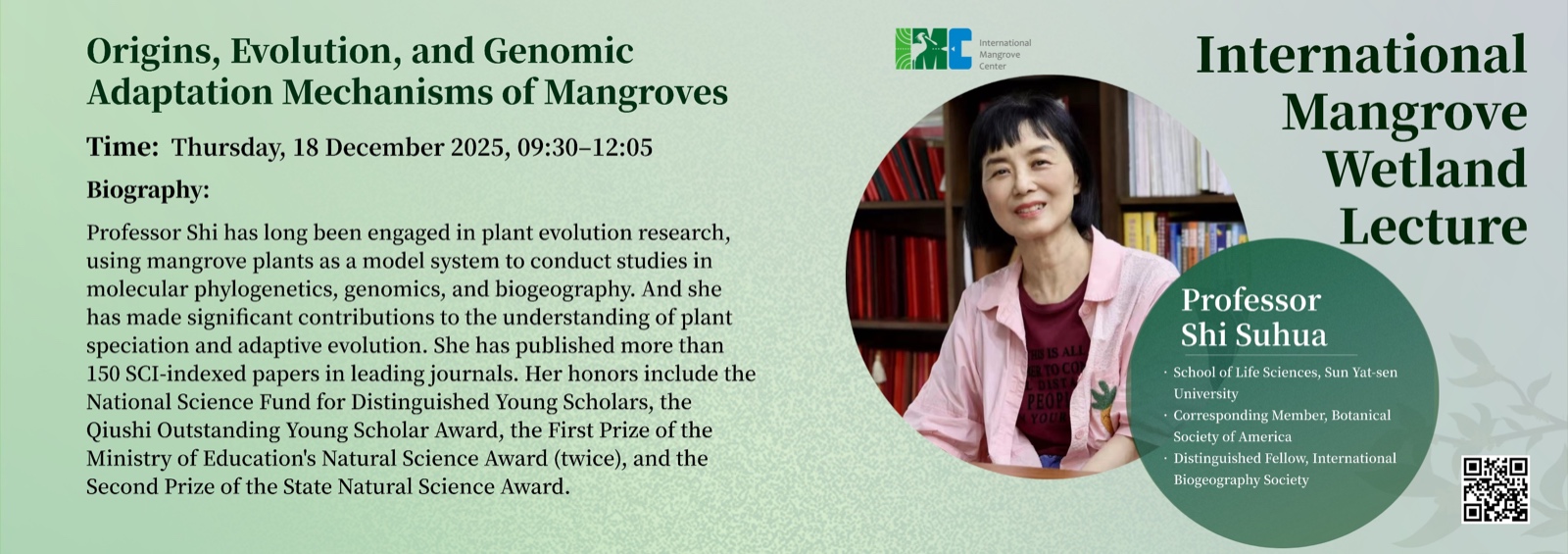
Professor Shi, an expert in plant evolutionary biology, has long used mangrove plants as a model system for studies in molecular phylogenetics, comparative genomics, population genetics, and biogeography. She explained that mangroves have undergone multiple historical population bottleneck and differentiation events throughout their evolutionary history. Ancient whole-genome duplication (WGD) events have played a key role as evolutionary buffering mechanisms, helping to preserve essential functional genes while also enabling genome streamlining. Notably, gene regulatory networks and chromatin openness remain highly stable under environmental fluctuations, even more so than in inland species.
Professor Shi also pointed out that habitat fragmentation may reduce effective population size and genetic diversity, leading to cryptic ecological risks. She emphasized that mangroves generally exhibit low overall genetic diversity, with some populations showing low heterozygosity, which increases their extinction risk. Under compounded pressures, such as extreme climate events and human activities, some regions may experience sudden degradation.
During the Q&A session, Professor Shi elaborated on the complex, long-term evolutionary and adaptive processes of mangroves in land-sea ecotones, integrating perspectives from evolutionary biology, ecology, and genomics. She stressed the importance of incorporating genetic diversity conservation into long-term mangrove conservation and restoration strategies. Additionally, she highlighted the value of technological approaches, such as UAV-based monitoring, to collect high-resolution data and track species status over time.
The lecture deepened participants' understanding of the genetic vulnerability and adaptive capacity of mangrove ecosystems, offering scientific insights that can inform the development of long-term strategies for mangrove conservation, restoration, and climate change adaptation. Participants expressed a greater appreciation for the significance of science-based research, the integration of ecological conservation and sustainable use, and the long-term promotion of international collaboration on mangrove conservation and restoration in the context of global change.