

Experts and scholars from the Shenzhen Data Management Center of Planning and Natural Resource (Shenzhen Geospatial Information Center), Development Research Center for Natural Resource and Real Estate Assessment, Shenzhen, the Northeast Institute of Geography and Agroecology of the Chinese Academy of Sciences, Beijing Normal University, Shenzhen University, the University of Hong Kong, and STAR.VISION Aerospace Group Limited, among others, visited the Interim Secretariat of the International Mangrove Center (IMC). The visit featured discussions on global mangrove monitoring, applications of AI-enabled remote sensing, and joint development and sharing of digital platforms.
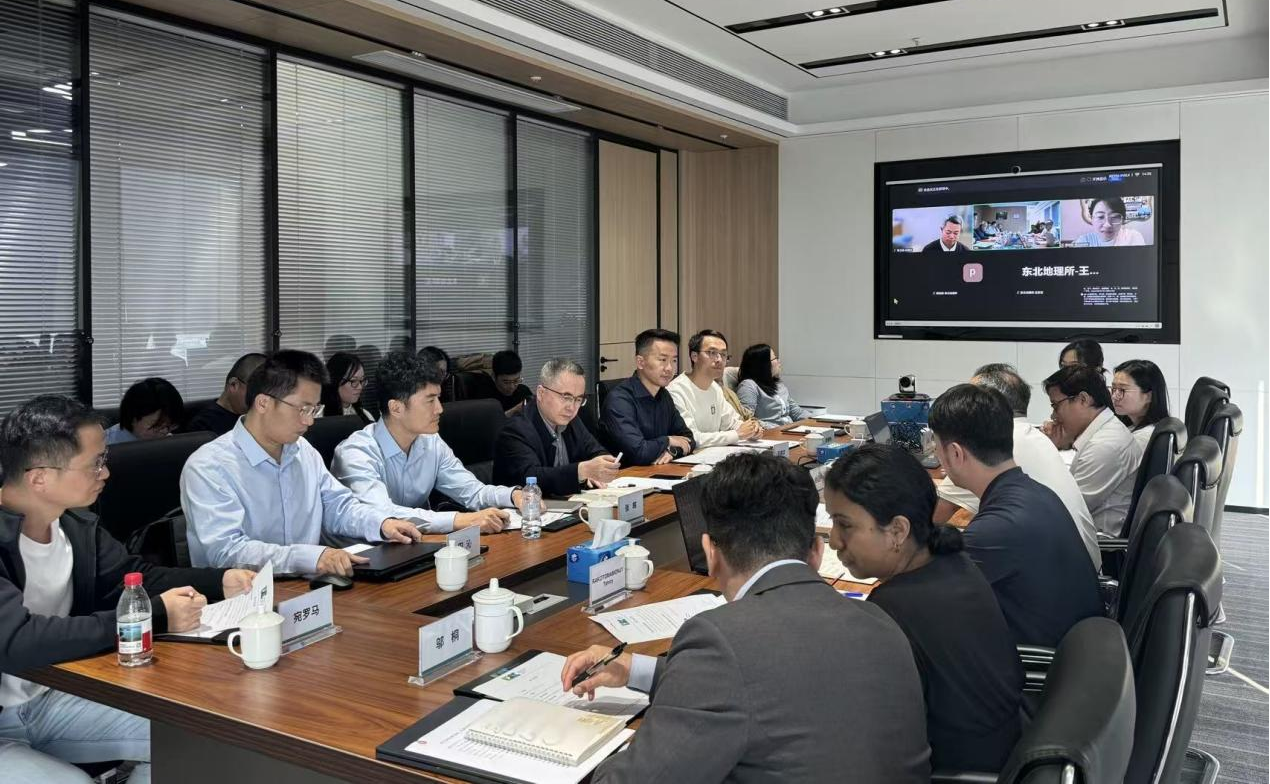
Representatives from universities, research institutes, and private sector engage in dialogue with the IMC Interim Secretariat
Prof. Bao Daming, Director General of the IMC Interim Secretariat, welcomed the delegation and outlined IMC’s vision for global mangrove monitoring and the co-development and sharing of related data products. He emphasized the IMC’s strong commitment to the scientific rigor, precision, and credibility of monitoring data, and expressed IMC’s expectation to collaborate with research institutions, technology enterprises, and local authorities to progressively establish a globally oriented, sustainably updated mangrove monitoring and service system. The goal is to provide authoritative and practical data products and services for Member States and stakeholders worldwide.
Mr. Fan Lianghua, Co-founder of STAR.VISION Aerospace Group Limited, together with his team, presented the company’s technical roadmap and practical achievements in AI satellites, intelligent remote sensing, and mangrove monitoring. He introduced “Mangrove 007”—the world’s first intelligent mangrove monitoring and analysis platform—currently in operational use. By integrating high-resolution remote sensing imagery with AI-based automated identification, the platform enables intelligent analysis of mangrove distribution, change trends, and degradation risks. He expressed interest in deepening cooperation with the IMC on platform co-development, data sharing, and international outreach to jointly enhance global digital mangrove monitoring capacity.
Mr. Chen Xueye, Director of the Shenzhen Data Management Center of Planning and Natural Resource (Shenzhen Geospatial Information Center), highlighted Shenzhen’s continued advancement in city-scale 3D geospatial modeling in recent years. Through the integrated application of drone-based aerial surveys and LiDAR technologies, Shenzhen has implemented multi-source data fusion in key ecological areas such as the Futian Mangroves, achieving urban 3D models with resolutions as fine as 3.5 centimeters. These practices have generated replicable experience in refined mangrove representation, ecological management, and carbon sink research. He noted IMC’s willingness to strengthen collaboration with the IMC to promote wider application and sharing of relevant technological achievements.
Mr. Zhang Hui, Director of the Development Research Center for Natural Resource and Real Estate Assessment, Shenzhen, shared outcomes achieved at COP30, with particular emphasis on Shenzhen’s mangrove carbon trading mechanisms and financial service innovations. He also announced the release of the Methodology for Mangrove Conservation, which has enhanced international awareness of the economic value of mangroves. At the same time, he noted that biomass estimation based on handheld device scanning still entails significant uncertainty, underscoring the urgent need for advanced technologies to improve efficiency and accuracy. He expressed the hope that the IMC platform would facilitate closer engagement with relevant technical partners.
During the discussion session, participants exchanged views on topics including multi-source remote sensing data integration, field sample validation, long-term platform operation mechanisms, and international data sharing. There was broad consensus that research institutions, government agencies, and technology enterprises should leverage their respective strengths and enhance coordination to foster an open and sustainable global mangrove monitoring and service system.
The exchange laid a solid foundation for future collaboration between the IMC and participating institutions in remote sensing monitoring, digital platform development, and international cooperation. Moving forward, the IMC will continue to integrate complementary resources, promote the international application and practical translation of high-precision mangrove monitoring achievements, and contribute to global mangrove conservation and sustainable management.