

Hong Kong, China November 30, 2025 — The International Mangrove Center (IMC) hosted a special session on mangrove remote sensing during the 7th China Wetlands Remote Sensing Conference and the 2025 Annual Academic Meeting of the Digital Wetlands Professional Committee. As one of the conference’s featured thematic workshops, the session brought together experts from leading research institutes and universities to exchange insights on mangrove spatiotemporal dynamics, conservation effectiveness, blue carbon assessment, species identification and biodiversity monitoring, as well as innovations in remote sensing technologies and ecological modeling. The discussion highlighted a broad range of cutting-edge research progress in these fields.
Hosted by Dr. Zhang Hongsheng, Secretary General of the 7th China Wetlands Remote Sensing Conference and the 2025 Annual Academic Meeting of the Digital Wetlands Professional Committee, he introduced the background of the event and the mandate of the IMC. Experts including Dr. Jia Mingming from the Northeast Institute of Geography and Agroecology of the Chinese Academy of Sciences delivered a series of in-depth presentations. Their reports traced nearly five decades of mangrove ecosystem changes in China and provided a comprehensive overview of national conservation and restoration trends.
The session also showcased the development of a space-air-ground-sea integrated monitoring network for mangrove carbon sinks in the Pearl River Estuary. Presenters demonstrated new applications of UAV hyperspectral images using machine learning models for mangrove species classification, biodiversity monitoring, and resilience assessments of Hainan’s mangrove ecosystems. Additional contributions covered advances in dynamic global vegetation model simulations for carbon cycling, remote sensing mapping of mangrove stand age across East Asia, and the development of nonlinear ecological process models, offering a glimpse into several frontier research directions.
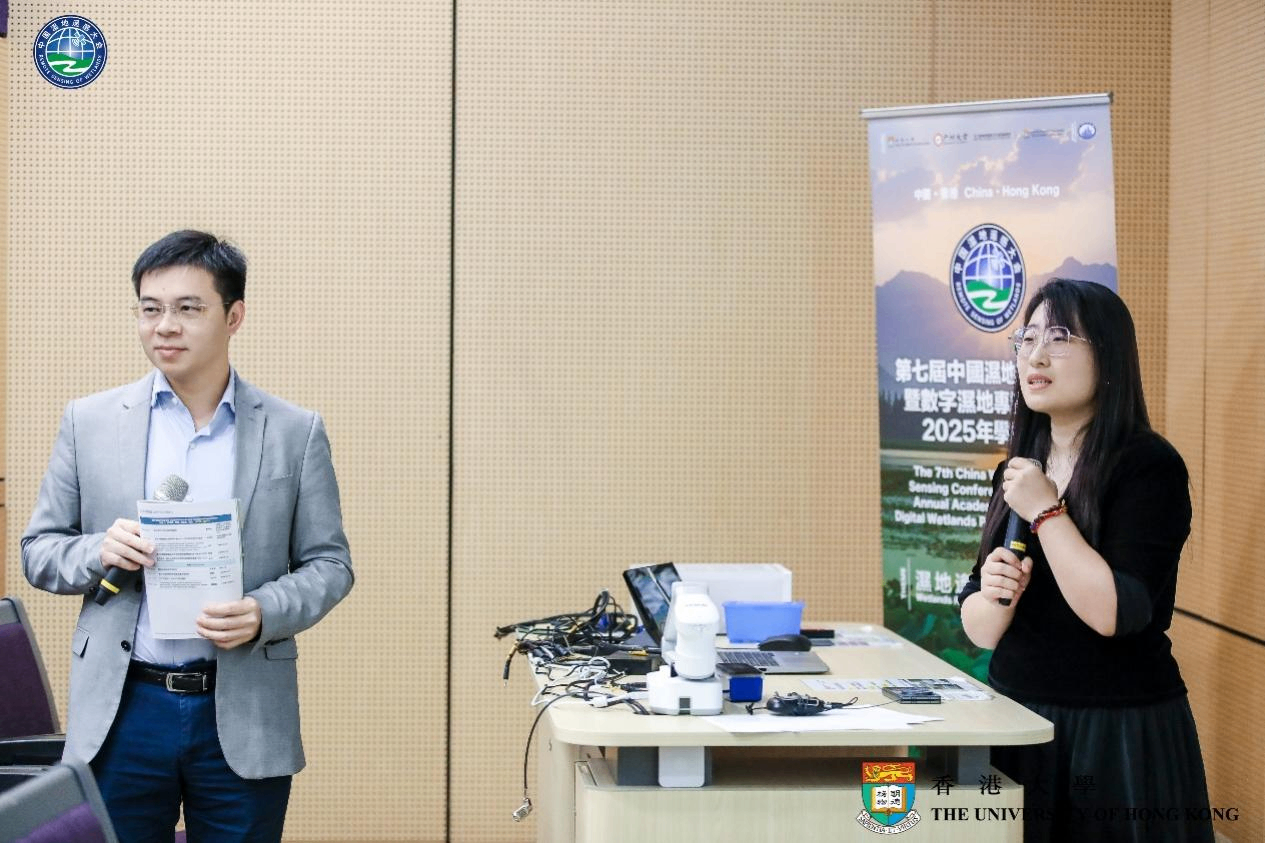
Photo: IMC Special Session at the Conference
During the session, Peng Peng, Director of the Interim Secretariat of the IMC, highlighted that the IMC, as an open, collaborative, and action-oriented international platform, is committed to advancing knowledge sharing and scientific cooperation in mangrove conservation, restoration, and wise and sustainable use. He noted that the scientific outputs featured at this meeting will provide strong support for the IMC’s future work in global mangrove governance. Building on this opportunity, the IMC will further strengthen collaboration with research institutions, universities, and international partners, promote the establishment of mangrove remote sensing monitoring networks and blue carbon assessment methodologies, and continue enhancing scientific and technological capabilities to accelerate global mangrove conservation efforts.